PhD Thesis
2011-2014
"Modelling of Natural Dialogues in the Context of Speech-based Information and Control Systems"
Being able to communicate with machines by means of natural language is a long cherished dream of mankind. Consequently, it has been a central topic in many Science Fiction movies ever since. Apart from these fictional stories, today’s speech dialogue systems often encounter criticism. In this dissertation, a model that addresses this criticism is developed in order to create more natural dialogue systems. This includes a study about the users’ preferences and required features, the classification of utterances according to intention and answer type, the generation of system utterances, and the combination into a model that describes the characteristics and the information demand of the dialogue and that can be automatically processed by a dialogue engine. This research focusses on information and control systems, i.e. systems with clearly defined tasks, like travel booking or smart room control. [Berg, 2014]
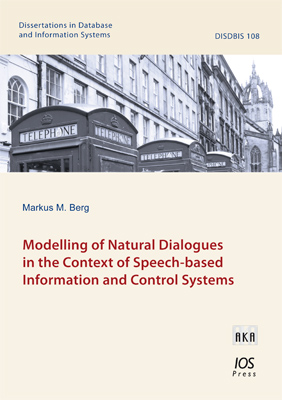
For more information, try out NADIA - the Natural Dialogue System or have a look at the PhD thesis:

Research Projects
MAIKE, 2008-2010
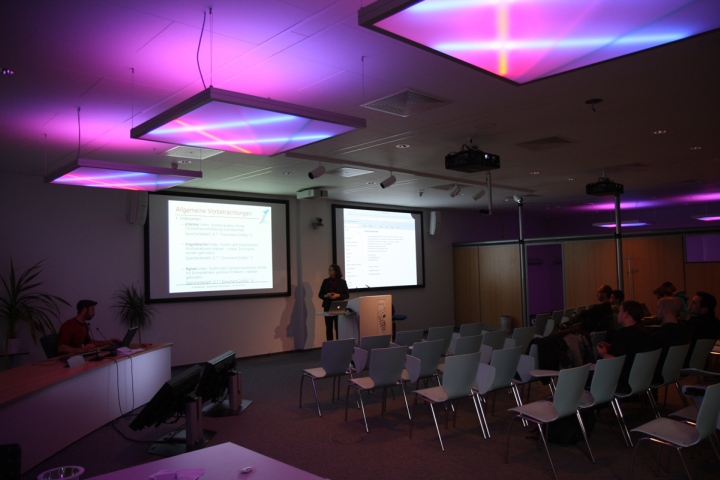
The aim of the project Mobile Assistive Systems for Intelligent, Cooperative Rooms and Ensembles was the development of services that facilitate the interaction in work environments (e.g. conference rooms). In this project we have developed a speech interface for smart rooms. Parts of this project and parts from my Master's Thesis have been integrated into our new "Multimedia Center" at the University of Wismar, that you can see on the picture.
In cooperation with: University of Rostock, Basis GmbH, brown-iposs GmbH. Supported by the Ministry of Economy of Mecklenburg-Vorpommern and the European Union (ESF, EFRE).
Travel Consult, 2008-2010
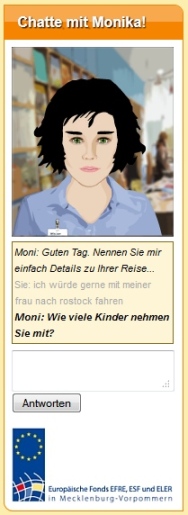
Current tourism information and -booking portals offer the user a form-based interaction with a vast amount of settings that confuses many users. In this project we have developed a text-based dialogue system, that allows the user to interact with the system by means of natural language.
In cooperation with: MANET Marketing GmbH. Supported by the Ministry of Economy of Mecklenburg-Vorpommern and the European Union (ESF, EFRE).

Non-Funded Projects
- Speech Processing Systems for Visually Impaired People, 2010
In cooperation with: University of Rostock - Storyboard Design and Natural Language based Dialogues, 2010
In cooperation with: University of Kiel - eOhr (electronic ear) Version 2, 2009
In cooperation with: Basis GmbH (industrial partner)
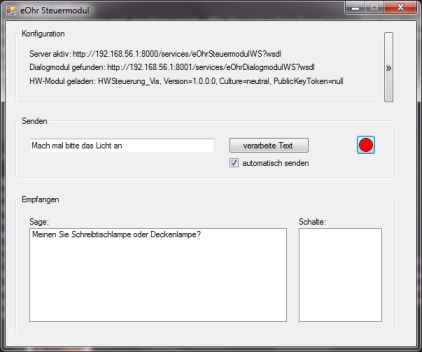
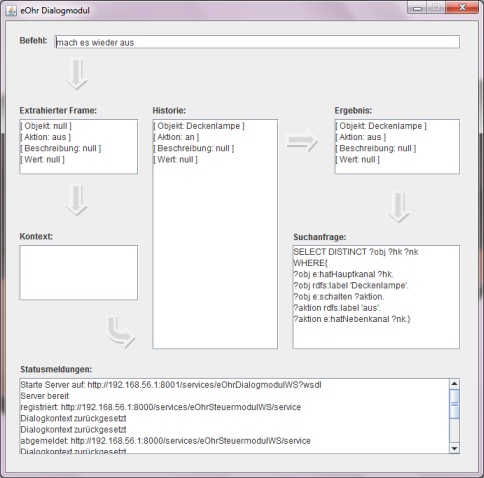
The electronic ear (Version 1) is a speech interface for smart rooms that has been developed by Ole Grelck and Nicole Fernholz. In my Master's Thesis I redesigned this programme. It now uses an ontology to represent domain knowledge, includes dialogue features and intelligent questions and is able to do basic anaphora resolution. The graphical representation of the simulation has been realised by Martin Pfaff.